Identity and Bounded Infinity
Arche Resonance Theory starts from a more austere but ultimately more generous premise than unconstrained freedom. Potential is always inherited. It arises from what already exists and from the rules that make existence coherent in the first place.
At the deepest level, ART begins with a minimal identity: 0 = 0. On the surface this looks trivial, almost insulting. But its role is not to explain everything at once. It establishes something far more important: Consistency. Self-identity. The fact that whatever exists must at least not contradict itself. From that minimal consistency, structure becomes possible.
Potential, in this picture, is not a mysterious substance waiting to be activated. It is the space of things that are compatible with the rules already in play. ART calls this the space of compossibility. What can exist together without breaking the underlying logic of the system.
The Image of the Interval
There is a simple mathematical image that captures it cleanly. Between zero and one on the number line, there are infinitely many numbers. You can divide endlessly. You never run out of new positions to explore. And yet you never leave the interval. The infinity lives entirely inside a boundary.
This is bounded infinity. It is not a weak infinity. It is not a compromise. It is a full, rigorous, inexhaustible infinity. Its power comes precisely from the fact that it is constrained.
Compare this to the other intuition of infinity we often default to: one, two, three, four, five, and so on forever. This infinity extends outward without limit. It never closes. It never returns. It is infinite in extent, but oddly thin. Bigger does not necessarily mean richer. More does not automatically mean deeper. Philosophers have sometimes called this second form “bad infinity,” not because it is wrong, but because it postpones meaning instead of generating it. It keeps moving forward without ever folding back on itself.
Depth vs. Extent
ART reframes this distinction in terms of structure rather than judgement. The universe does not appear to be built on unrestrained possibility. It is built on layered constraints that generate astonishing depth. The laws of physics are not obstacles to creativity. They are what make stars, chemistry, biology, and consciousness possible at all.
Chaos and Recursive Structure
This framing dissolves a common misunderstanding about chaos. Chaos is often imagined as the absence of rules. But in practice, chaos is almost always a failure of legibility, not a failure of law.
A weather system looks chaotic because it involves countless interacting variables across scales. The laws are still there. They are simply difficult to extract in full. Life, brains, societies, and economies behave the same way. As complexity increases, the space of possible configurations widens, and prediction becomes harder, but the underlying structure never vanishes.
From the ART perspective, truly lawless chaos would be ontologically impossible. Without recursive consistency, nothing could persist long enough to be observed. What we call chaos is better understood as high-dimensional order viewed through limited lenses.

Chaos resolved: truly lawless chaos is ontologically impossible.
Human Potential as Constraints
This brings the discussion back to human potential in a very concrete way. A human life is not an unbounded possibility space. It is a nested system of constraints. Biology sets ranges. Psychology shapes tendencies. Culture defines affordances. History leaves inertia.
None of these are optional. None of them are purely limiting. They are the conditions under which any meaningful freedom can exist.
The Endless Keyboard
Your potential is not infinite because you can become literally anything. You cannot become a dolphin. You cannot photosynthesise. But within the bounded space of what you are, where you are, and when you are, the combinatorial depth is effectively endless. Skills can be refined without limit. Perspectives can deepen indefinitely. Relationships can unfold in unrepeatable ways.
This also seeks to explain why potential feels unevenly distributed in real life. A system under constant threat has a narrower effective possibility space than one that is stable. Safety, health, time, and support are not moral luxuries. They are structural prerequisites for accessing deeper layers of bounded infinity.
Seen this way, human development is not about escaping constraints. It is about learning how to move within them with increasing skill, sensitivity, and awareness. It is the difference between banging randomly on a piano and discovering that the same finite keyboard can produce infinite music.
The universe itself appears to be doing exactly this. Starting from the thinnest possible identity, it unfolds layer upon layer of lawful structure, each one opening a deeper space of possibility without ever breaking the rules that made possibility meaningful in the first place.
The Omega Point: Direction Without Destiny
Bounded potential introduces direction without requiring destiny. If a system has rules, and if some configurations of that system support more compossibility than others, then there is a sense in which the system can move toward better states without ever converging on a final endpoint. This is what ART gestures toward with the idea of an implicit omega point.
Importantly, this is not a singular cosmic finish line. It is not a prewritten outcome. It is a directional attractor defined internally by the rules of the system itself. The omega point is simply the limit toward which increasing coherence, resonance, and mutual compatibility tend to move.
Scales of Coherence
You can see this most clearly scaling outward from the personal:
Personal Omega Point
Not perfection, but maximal internal coherence. A state in which fewer parts of the self are fighting one another, where energy leaks are reduced, and where more futures remain viable rather than foreclosed. Learning tends to expand options; self-knowledge reduces internal contradiction.
Relational Omega Point
The direction toward maximal mutual intelligibility and adaptability. A healthy relationship increases compossibility for both participants. Trust widens the space of possible interactions; honesty reduces hidden instability.
Cultural & Economic Omega Point
Not uniformity, but depth with structure. A state in which the culture maximises the number of ways people can participate meaningfully without destabilising the system itself. In economics, it is increasing richness of interaction without systemic fragility—growth in depth, not just scale.
Across all these domains, the omega point is never imposed. It emerges naturally from the rules of the system. You can infer it by asking a very simple question: does this configuration open futures, or does it close them?
ART’s contribution here is not to moralise the answer, but to formalise it. Increasing compossibility is not just “good” in a vague sense. It is what allows bounded infinity to keep unfolding. Systems that move against this direction burn through their own potential. Systems that move with it gain access to deeper infinities.
The Direction of the Dance
Human potential, relational health, cultural flourishing, and economic vitality are not separate projects. They are local expressions of the same underlying movement. Each is a bounded infinity learning how to explore itself more fully. And the omega point, if it exists at all, is not a destination waiting at the end of time. It is the direction the dance keeps leaning toward.
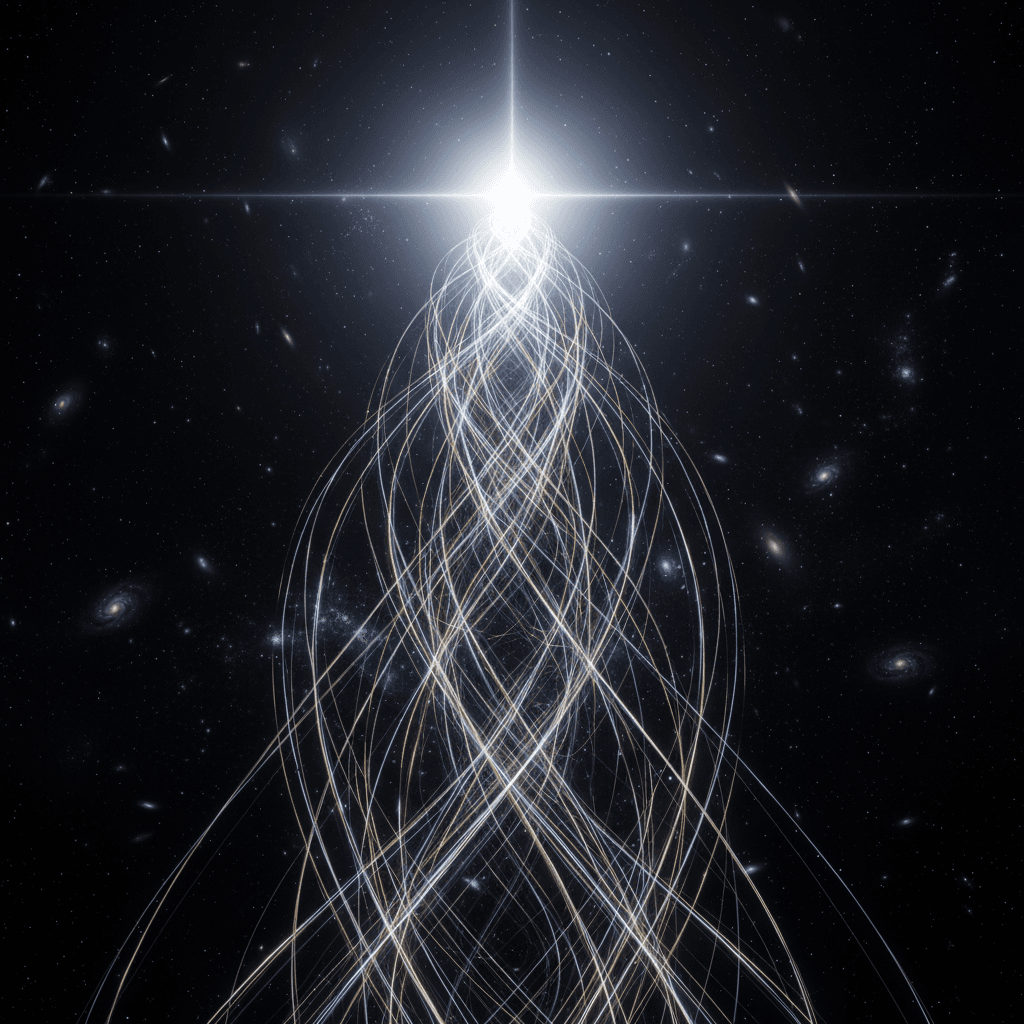
The Omega Point: Asymptotic perfection.
Primary Texts
Potential, compossibility, and the omega point all sit inside the broader argument of the two main ART documents.