The Conflict of Foundations
When quantum mechanics was formalized, it revealed that the evolution of a system had to preserve its internal structure. States could change, interfere, and spread out, but they could not leak out of the space of possible states. This requirement came to be called unitarity. At the time it looked like a technical condition, but in retrospect, it was a philosophical declaration.
General relativity grew from a different soil. It took spacetime itself as the foundation and described gravity as geometry. While elegant, it assumes spacetime remains a valid arena under all conditions. Black holes expose the cost of that assumption. When mass is concentrated beyond a limit, the equations predict their own failure. Geodesics cannot be continued; coordinates lose meaning.
"The problem is not excess quantity in nature. The problem is the limits of the spacetime description itself."
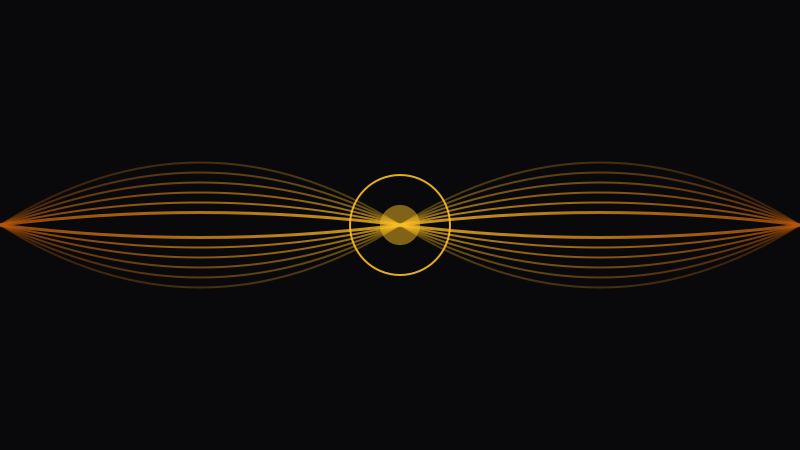
This is where the tension lives. Quantum theory insists on unitarity and information preservation. Relativity, taken literally, allows regions where description breaks. If spacetime were fundamental, these two commitments would be incompatible.
The Frequency Domain Solution
Arche Resonance Theory proposes a quiet but radical change of perspective. It begins with the Frequency Domain—a complex spectral structure where states exist as coherent phase relations.
In this domain, evolution is unitary by construction. The structure is closed; nothing can fall out of it. Spacetime, in this view, is not where physics happens—it is what physics looks like when this deeper domain is projected into a limited representational frame.
Once this shift is made, the pieces interlock. Unitarity belongs to the frequency domain, not to spacetime. A singularity signals that the spacetime projection has reached a point where it ceases to be one-to-one.
Black Holes as Projection Limits
Black holes become straightforward in this framework. They mark regions where spacetime compactifies an infinite frequency-domain structure into a single locus.
- The projection from frequency structure into local spacetime geometry becomes non-injective.
- Distinct underlying states map to the same spacetime configuration.
- From within spacetime, this appears as an Event Horizon and apparent information loss.
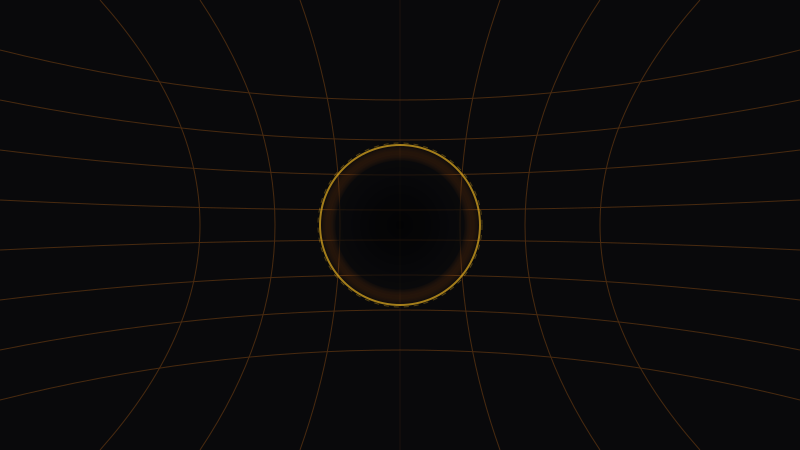
From the deeper domain, nothing has been destroyed. The structure remains intact but has been identified (collapsed) rather than resolved. This naturally explains the Holographic Principle: when interior projection fails, the boundary becomes the last place where distinctions can be maintained. Information scales with area because area is where the projection still has resolution.
The Universe as a Projection
This resolves the provocative suggestion that our universe resembles the interior of a black hole. The observable universe can be read as a maximal, self-consistent projection region of an underlying reality. Its cosmological horizon plays the same structural role as a black hole horizon—marking the limit beyond which spacetime descriptions cease to apply.
The failure belongs to Materialism in its naive form—the insistence that spacetime is the ground of being.
Long ago, Einstein warned us not to confuse our concepts with reality itself.
Black holes are spacetime taking that advice seriously. They show, with mathematical precision, that we have reached the limits of one language and must look to a deeper one to continue the conversation.